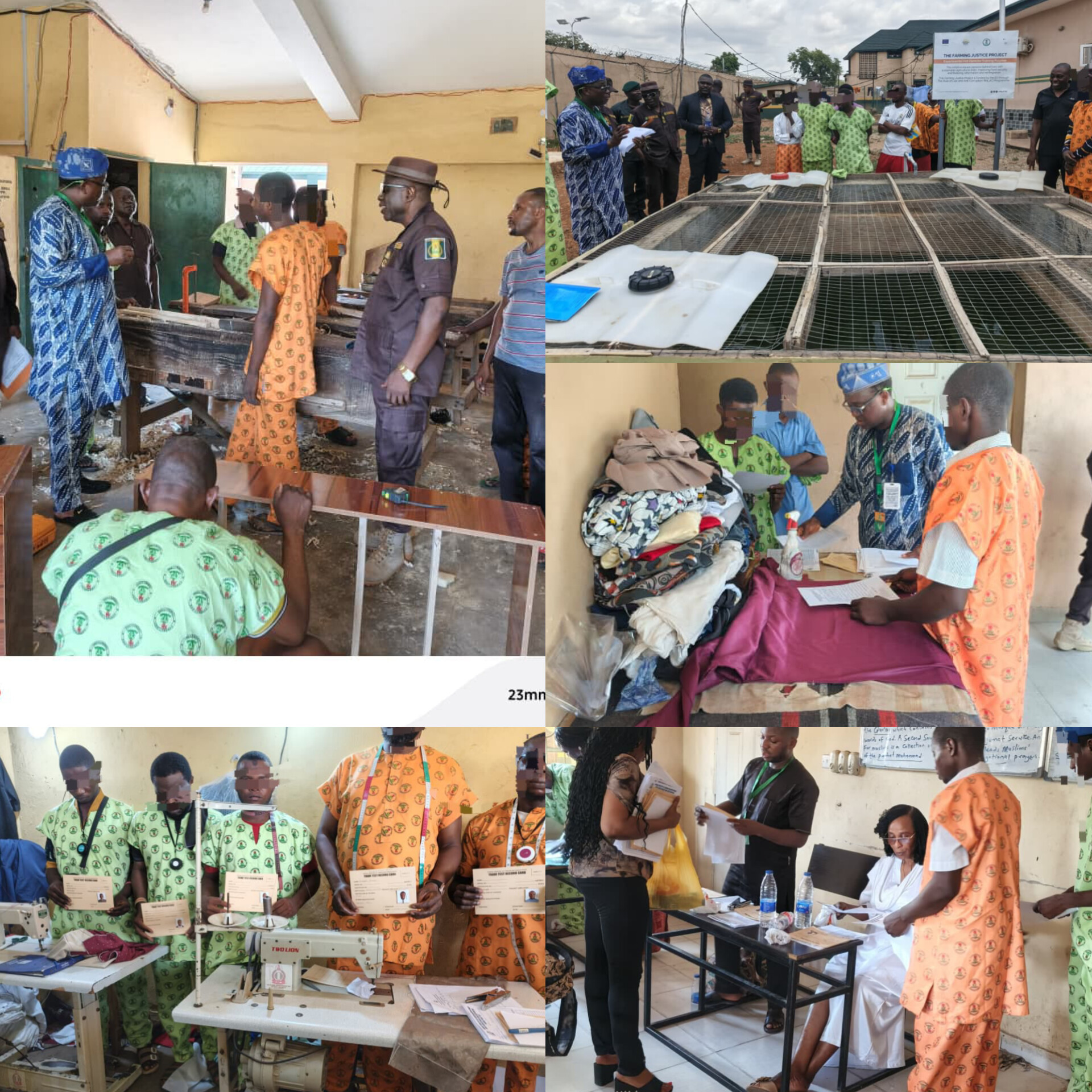
The Federal Ministry of Labour and Employment has screened 144 inmates at the Medium Security Custodial Centre in Kuje, Abuja, for nationally recognised Trade Test Certificates as part of efforts to strengthen inmate rehabilitation and reintegration.
The exercise, conducted on May 13, 2026, was carried out by a delegation from the ministry led by Engr. Gabriel Olakunle Ojelade. The team administered both practical and theoretical examinations to assess the inmates’ competence in various vocational trades.
Speaking during the exercise, Ojelade said the Trade Test Certificate is an official recognition of professional competence that is valid across the country and would improve the beneficiaries’ chances of securing lawful employment and becoming self-reliant after release.
He explained that the assessment process included physical verification, attestation, and written and practical examinations to ensure only qualified candidates received certification.
Out of 152 inmates who applied for the programme, 144 were successfully screened across 12 vocational areas, including building construction, poultry, fishery, cap making, tailoring, shoe making, barbing, carpentry, soap making, tie and dye, laundry, and bag making.
Reacting to the development, the Controller of Corrections, FCT Command, CC Christopher Peter Jen, expressed appreciation to the Ministry of Labour and Employment on behalf of the Controller-General of Corrections, Sylvester Ndidi Nwakuche, for extending the certification programme to inmates at the custodial facility.
Describing the initiative as a “dream come true,” Jen noted that many inmates had undergone extensive vocational training and were awaiting formal recognition of their acquired skills.
He added that the certificates would not only confirm vocational competence but also attest to the good conduct and character of the beneficiaries.
Jen said the programme reflects the commitment of the Nigerian Correctional Service to effective reformation, rehabilitation, and reintegration of inmates, while urging beneficiaries to become productive citizens upon their return to society.
The initiative is part of ongoing collaborative efforts aimed at equipping inmates with marketable skills, reducing recidivism, and promoting successful reintegration after custody.