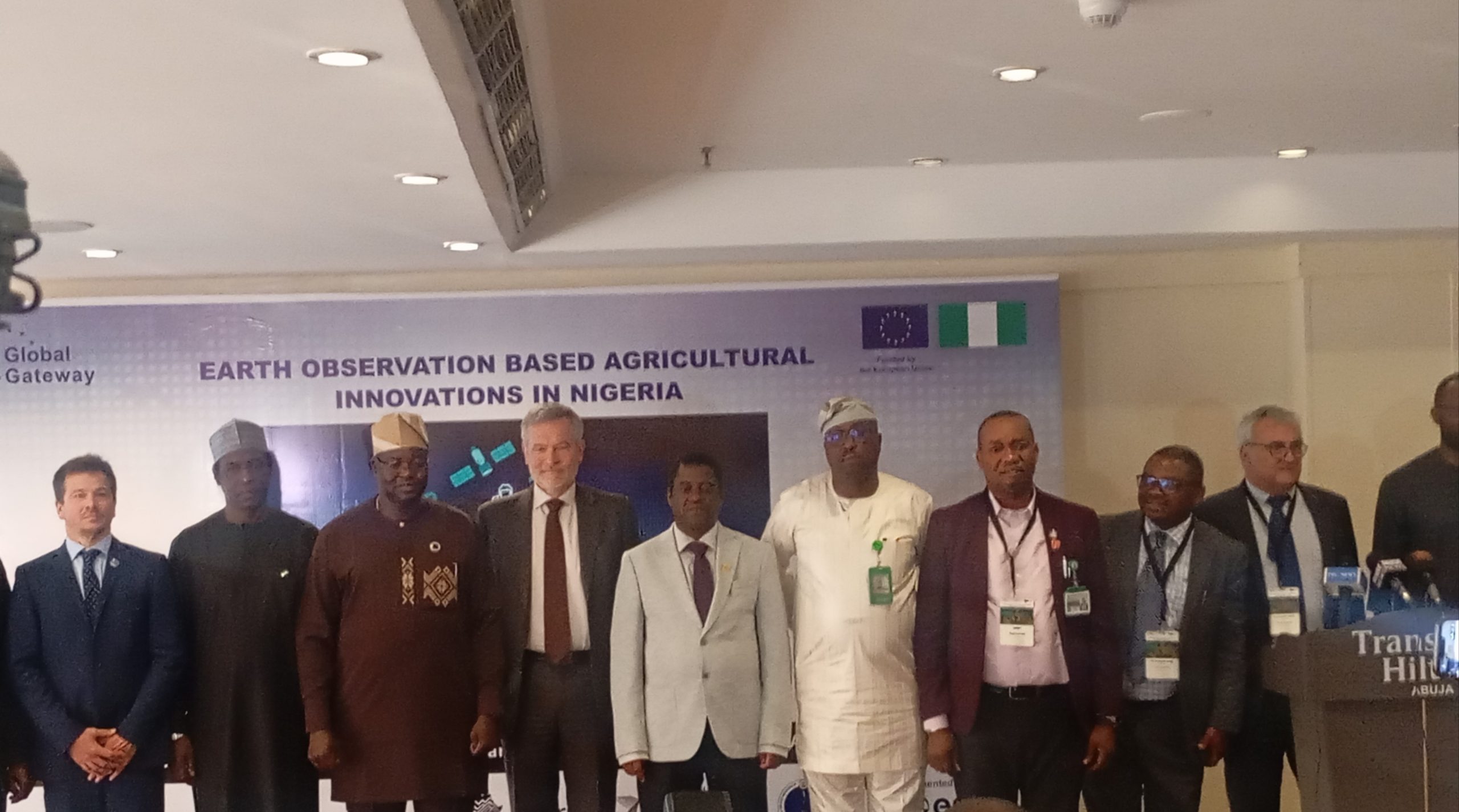
The Federal Government has unveiled a new Earth Observation–based initiative aimed at modernising Nigeria’s agricultural sector through the application of satellite technology and geospatial data.
The project was formally presented at a kickoff workshop held in Abuja, where the Minister of Innovation, Science and Technology, Dr. Kingsley Tochukwu Udeh—represented by the Permanent Secretary, Muktar Yawale—described the initiative as a strategic intervention to improve agricultural productivity, sustainability, and resilience across the country.
He commended the National Space Research and Development Agency (NASRDA) for its continued leadership in deploying space science for national development, while also acknowledging the support of the European Union and the European Space Agency.
According to him, the collaboration demonstrates a shared commitment to leveraging innovation for sustainable growth and food security.
The Minister noted that the initiative comes at a critical time, as Nigeria’s agricultural sector continues to face challenges such as climate change, land degradation, environmental pressures, and rapid population growth.
He stressed the need for innovation-driven solutions, highlighting data and technology as key tools for transforming food systems.
He further explained that the project aligns with President Bola Ahmed Tinubu’s Renewed Hope Agenda, which prioritises agriculture as a central pillar of economic recovery.
The administration, he said, is focused on achieving food security, reducing food imports, strengthening agricultural value chains, and promoting modern farming techniques.
The initiative will deploy satellite-based systems and geospatial intelligence to deliver real-time, reliable data for farmers, policymakers, and stakeholders.
This is expected to enhance crop monitoring, support environmental risk assessments, improve land-use planning, and strengthen evidence-based decision-making across the agricultural sector.
Beyond technology deployment, the Minister emphasized that the project will also build institutional capacity, encourage cross-sector collaboration, and expand the use of space-based solutions within agricultural planning and implementation.
Meanwhile, NASRDA’s Director of Strategic Space Applications, Dr. Godstime James, said the project reflects Nigeria’s commitment to addressing agricultural challenges through science and innovation.
He explained that integrating satellite imagery, remote sensing, artificial intelligence, and Internet of Things (IoT) tools would enable real-time monitoring of farms, improve yield forecasting, and provide early warning systems for climate-related risks such as floods and droughts.
He added that the project, funded by the European Union and implemented by the European Space Agency in partnership with GAF AG, will be piloted in selected states including Kano, Bauchi, Plateau, Oyo, Enugu, Cross River, and the Federal Capital Territory. Farmers will also receive updates on weather conditions, pest outbreaks, crop suitability, and market prices through mobile platforms and USSD services.
The EU Ambassador to Nigeria, Gautier Mignot, described the initiative as a €2.7 million Euro-African collaboration designed to empower farmers and herders with space-based information and promote modern agricultural practices.
Stakeholders say the project marks a significant step toward building a more data-driven, resilient, and technology-enabled agricultural system in Nigeria.