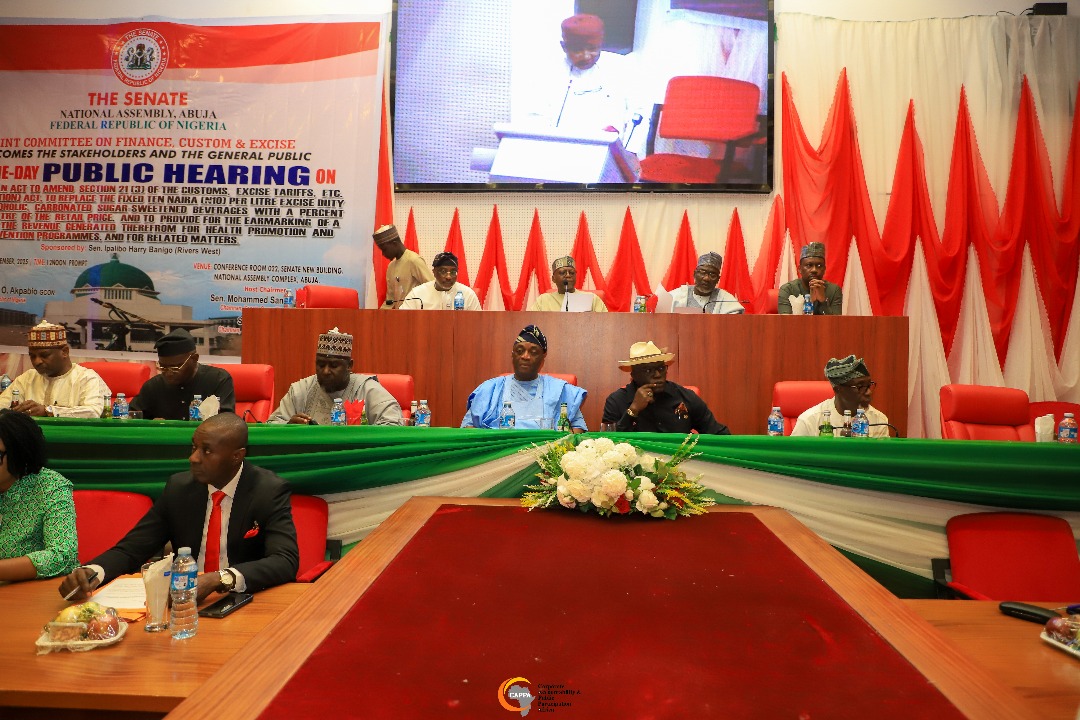
Nigeria’s ongoing review of the excise duty on sugar-sweetened beverages (SSBs) has reignited debate over whether corporate profits should outweigh public health concerns, as lawmakers consider sweeping changes to the current tax framework.
The discussion gained momentum in November 2025 when the Senate Joint Committee on Finance, Customs and Excise held a public hearing in Abuja on a bill seeking to amend the existing SSB excise duty. The proposed legislation aims to replace the fixed ₦10 per litre tax on non-alcoholic, carbonated sugar-sweetened drinks with a levy calculated as a percentage of the retail price, while earmarking part of the proceeds for health promotion and disease-prevention programmes.
Sponsored by Senator Ipalibo Harry Banigo, the bill is driven by mounting medical evidence linking the consumption of sugary drinks—including soft drinks, energy drinks and sweetened juices—to the rising prevalence of non-communicable diseases (NCDs) in Nigeria.
At the hearing, Senate President Godswill Akpabio, represented by Senator Adeniyi Adegbonmire, described the proposal as more than a fiscal adjustment. He said the amendment represents a public-health investment strategy designed to align tax policy with national health priorities and channel part of existing revenues into health-related infrastructure and programmes.
Health experts note that SSBs are globally recognised contributors to obesity, type 2 diabetes, cardiovascular diseases and premature deaths. In Nigeria, consumption of sugary drinks—particularly among young people—has increased significantly, while NCDs are estimated to account for nearly 30 percent of annual deaths.
Nigeria has also become one of the fastest-growing markets for sugary beverages worldwide, with reports indicating that the average consumer drinks about six bottles weekly, spending roughly ₦2,500. This trend has coincided with rising healthcare costs and increasing pressure on the country’s already strained health system.
Recent figures from the Diabetes Association of Nigeria indicate that about 30,000 Nigerians die from diabetes annually, while an estimated 11.4 million live with the condition. Monthly treatment costs, ranging between ₦100,000 and ₦120,000, remain beyond the reach of most households. Access to specialised care is similarly limited, with fewer than 100 heart surgeons and only a handful of cardiac centres serving a population of over 200 million.
Nigeria introduced an excise duty on SSBs in 2021 through the Finance Act, inserting Section 21(3) into the Customs and Excise Tariffs Act. However, analysts argue that the current ₦10 per litre levy has lost relevance due to inflation and rising retail prices. While a 33cl bottle of soft drink sold for about ₦100–₦150 in 2021, prices now range between ₦350 and ₦500, leaving the tax with minimal impact on consumption or product reformulation.
The debate is unfolding amid broader concerns about health financing. Nigeria allocates less than five percent of its national budget to health, far below the 15 percent target set under the 2001 Abuja Declaration. Observers also note that recent development levies prioritised sectors such as education, technology and security, with no dedicated allocation for health.
Supporters of the proposed amendment argue that a retail-price-based SSB tax would better discourage excessive consumption, encourage manufacturers to reduce sugar content and generate sustainable funding for health programmes. They also point to international precedents, noting that more than 50 countries—including South Africa, Mexico and the United Kingdom—have adopted similar measures without widespread job losses.
Industry groups, however, have warned that higher taxes could lead to factory closures and employment losses. Public-health advocates counter that such claims are overstated, citing continued profitability among beverage companies operating in Nigeria and across Africa.
The proposed reform has also faced criticism from some quarters branding it a “sugar tax,” a label lawmakers dispute. According to supporters, the levy targets sugar-sweetened beverages, not sugar itself, and does not affect farmers or traditional diets.
As deliberations continue at the National Assembly, analysts say the outcome will signal whether Nigeria is prepared to prioritise public health over industry pressure. With NCD-related healthcare costs estimated at nearly ₦1.92 trillion annually, proponents argue that strengthening the SSB tax is a preventive measure the country can no longer afford to delay.
Health
SSB Tax Reform Sparks Public Health Debate in Nigeria