Nigeria’s political parties must reclaim their constitutional responsibilities as institutions anchored on ideology, accountability and citizen participation to prevent further threats to democratic consolidation, scholars and democracy advocates have warned.
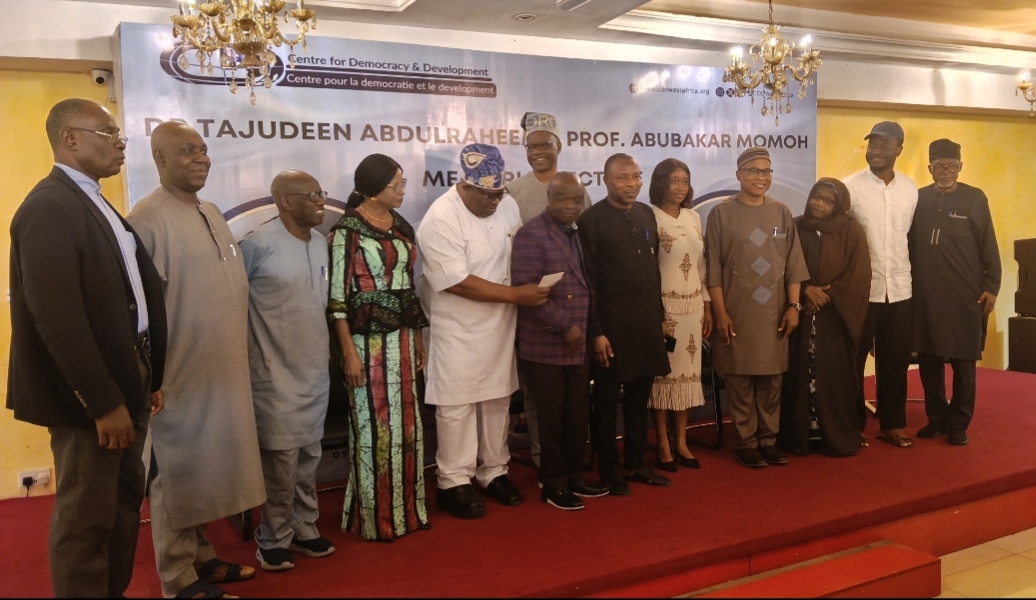
The call was made at the 2026 Dr. Tajudeen Abdul-Raheem and Professor Abubakar Momoh Annual Memorial Lecture organised by the Centre for Democracy and Development (CDD) in Abuja on Tuesday.
The lecture, themed “From Promise to Paralysis: Political Parties and the Challenges of Democratic Consolidation in Nigeria,” brought together academics, policy experts, civil society actors and democracy practitioners to examine the challenges confronting Nigeria’s democratic journey and honour the contributions of the late pan-African scholar-activists.
In his welcome address, CDD Director, Dr. Dauda Garuba, said the annual lecture was established to preserve the ideals of Abdul-Raheem and Momoh, whose advocacy for democracy, social justice and pan-Africanism shaped democratic discourse across Africa.
Garuba described the two scholars as founding pillars of CDD, noting that Abdul-Raheem, a Rhodes Scholar and former United Nations official, and Momoh, a Fulbright Scholar and former Director-General of The Electoral Institute under the Independent National Electoral Commission (INEC), dedicated their lives to promoting democratic governance beyond ethnic, religious and regional interests.
He lamented that many Nigerian political parties had abandoned their role as platforms for policy development, leadership growth and ideological engagement, instead becoming vehicles for elite competition and the pursuit of political power.
According to him, the growing internal crises, leadership disputes, prolonged court cases and disagreements over candidates ahead of the 2027 general elections highlight the urgent need for reforms within the party system.
Garuba stressed that democracy could only flourish when political parties become credible, internally democratic and responsive to citizens’ needs.
Also speaking, Chief Executive Officer of the African Policy Research Institute (APRI), Professor Nana Tanko, praised CDD for sustaining the memorial lecture, describing it as a valuable platform for reflecting on Africa’s democratic challenges while preserving the intellectual legacies of Abdul-Raheem and Momoh.
Tanko questioned the current purpose of political parties in Nigeria, asking whether democracy could survive when parties lack internal democracy and citizens participate only during elections without experiencing improved governance, dignity and accountability.
She noted that political parties were originally designed to aggregate interests, recruit leaders, educate citizens, promote peaceful competition and hold governments accountable.
However, she said many parties had weakened into electoral platforms driven by money politics, poor internal structures and limited connections with citizens.
Tanko added that Nigeria’s multiparty system had not automatically strengthened democracy, arguing that the quality of party organisation, transparency, inclusion and citizen engagement remained more important than the number of registered parties.
Delivering the keynote address, Professor Samuel Egwu of the Department of Political Science, University of Jos, identified weak institutional structures, poor internal democracy and the dominance of elite interests as major challenges affecting Nigeria’s political parties.
Egwu argued that many parties operate more as vehicles for powerful individuals rather than ideological organisations committed to public service.
He said political mobilisation in Nigeria continues to rely heavily on ethnic, regional and religious identities instead of clear policy alternatives capable of addressing national challenges.
The political scientist identified candidate imposition, disputed primaries, influence of wealthy financiers and lack of transparency as factors weakening internal party democracy.
He warned that when party members are excluded from candidate selection processes, elections merely validate decisions already made by political elites.
Egwu also criticised the frequent movement of politicians between parties, describing the trend as evidence of weak party identity and institutionalisation.
He said political defections without ideological consequences had reduced public trust and created the perception that parties are merely platforms for contesting elections rather than organisations built around shared values.
Reflecting on the 2023 general elections, Egwu noted that although electoral reforms and technology created optimism, controversies over result transmission, voter intimidation, vote-buying and post-election disputes affected public confidence in the electoral process.
He identified declining voter turnout as a sign of growing democratic frustration, warning that citizens’ increasing disengagement poses a major risk to democracy.
The professor further expressed concern over the fragmentation of opposition parties and fears of dominant-party politics ahead of the 2027 elections, noting that internal conflicts, defections and coalition struggles expose the weakness of the political system.
He also called attention to the exclusion of women, young people, persons with disabilities and other marginalised groups from leadership positions, candidate selection and political financing.
Egwu maintained that democratic consolidation would remain difficult unless political parties adopt inclusive structures that encourage wider participation.
He, however, argued that Nigeria’s political challenges are not permanent, saying they can be addressed through deliberate reforms, stronger institutions, ethical leadership and renewed civic engagement.
The speakers agreed that despite public frustration caused by insecurity, economic hardship, poor governance and declining trust in institutions, Nigerians remain committed to democracy.
They warned that voter apathy represents a growing danger and urged political actors to rebuild confidence by promoting transparency, inclusion, accountability and governance focused on citizens’ welfare.
Participants at the lecture were encouraged to develop practical solutions that would reposition Nigerian political parties as genuine democratic institutions capable of driving national development.
The annual memorial lecture remains one of CDD’s key programmes for preserving the legacies of Abdul-Raheem and Momoh while promoting evidence-based conversations on Africa’s democratic future.