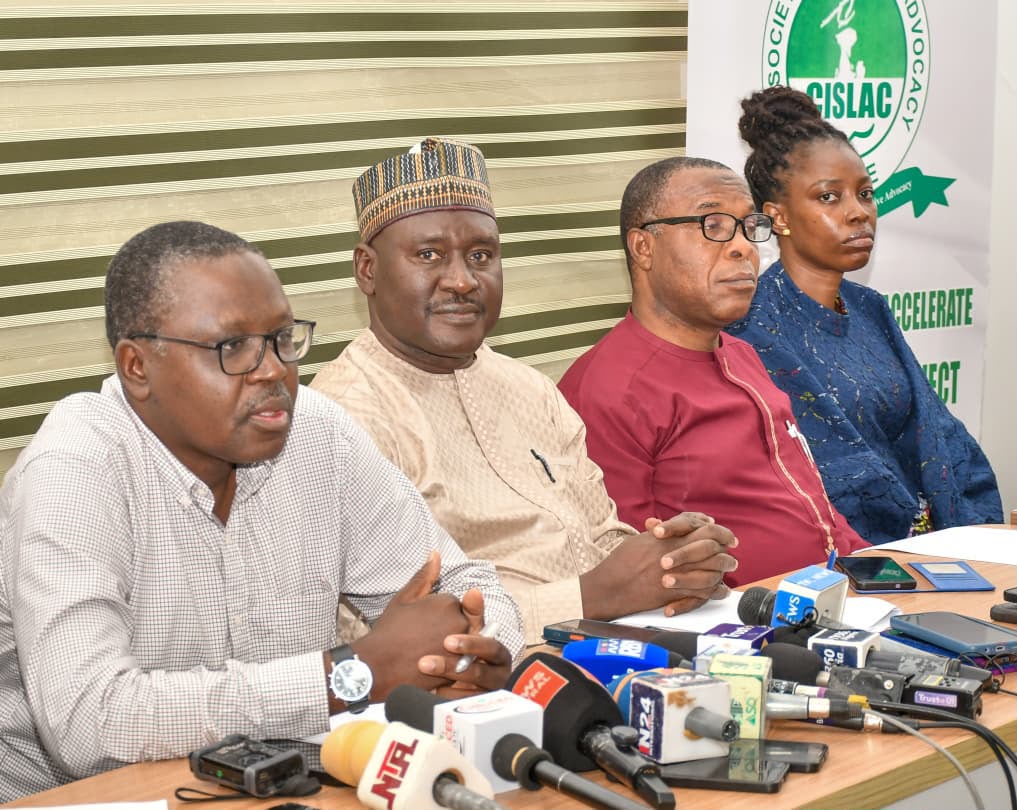
A coalition of Nigerian, African and international civil society organisations has urged the National Assembly to withdraw pending bills they described as repressive, warning that the proposed legislations could undermine civic freedoms, democratic governance and constitutional rights ahead of the 2027 general elections.
Addressing a joint press conference on Monday, the coalition expressed concern over what it described as a shrinking civic space in Nigeria, alleging that the country has witnessed increasing restrictions on freedom of expression, peaceful assembly, association, media freedom and access to information since President Bola Tinubu assumed office in May 2023.
The groups claimed that authorities have increasingly relied on restrictive laws, arbitrary arrests, prosecutions, lawsuits and intimidation against journalists, activists, media organisations and civil society groups.
They cited the continued prosecution of activist and publisher Omoyele Sowore, actions against the Socio-Economic Rights and Accountability Project (SERAP), and the use of the Cybercrimes Act against journalists and government critics as examples.
According to the coalition, the pending bills are part of a broader legislative effort to expand executive control over civil society, digital platforms and independent media while limiting public participation and accountability.
The organisations expressed particular opposition to the proposed Foreign Aids (Regulation, Transparency and Disclosure) Bill, 2026 (SB.1034), arguing that it would grant extensive powers to a proposed Foreign Aid Regulatory Commission to register, monitor, inspect and sanction organisations receiving foreign assistance.
They contended that the bill duplicates the responsibilities of existing agencies such as the Corporate Affairs Commission (CAC), the Economic and Financial Crimes Commission (EFCC) and the Special Control Unit against Money Laundering (SCUML), while imposing excessive registration, disclosure and reporting requirements on organisations regardless of their size or funding profile.
The coalition also criticised provisions requiring foreign-funded projects to align with government-defined national priorities, warning that such measures could interfere with the work of human rights groups, anti-corruption organisations, governance advocates and public interest litigants.
The groups further rejected a separate proposal seeking to compel social media companies to establish physical offices in Nigeria or risk being barred from operating in the country. They argued that the measure could increase government control over digital platforms, facilitate censorship, discourage innovation and restrict citizens’ access to information.
According to the coalition, both proposals violate constitutional guarantees of freedom of expression, association and peaceful assembly, as well as Nigeria’s obligations under the African Charter on Human and Peoples’ Rights, the International Covenant on Civil and Political Rights and other international human rights instruments.
The organisations maintained that international support for civil society remains essential for activities such as human rights monitoring, humanitarian assistance, election observation, anti-corruption advocacy and public interest litigation, insisting that such cooperation should not be treated as foreign interference.
They called on the Senate President, the Speaker of the House of Representatives and members of the National Assembly to immediately withdraw the Foreign Aids Bill, the social media regulation proposal and other bills they believe could restrict civic space.
The coalition also urged lawmakers to ensure future legislation complies with constitutional and international human rights standards, conduct broad consultations with stakeholders before passing laws affecting civic freedoms, and reaffirm Nigeria’s commitment to democracy, accountability, transparency and the rule of law.
More than 80 organisations endorsed the statement, including ActionAid Nigeria, Amnesty International Nigeria, BudgIT Foundation, the Centre for Democracy and Development (CDD), Connected Development (CODE), the Civil Society Legislative Advocacy Centre (CISLAC), the Centre for Journalism Innovation and Development (CJID), the International Press Centre (IPC), Media Rights Agenda, SERAP, Yiaga Africa, the Transition Monitoring Group (TMG), the Wole Soyinka Centre for Investigative Journalism (WSCIJ), and several other national, regional and international civil society organisations.