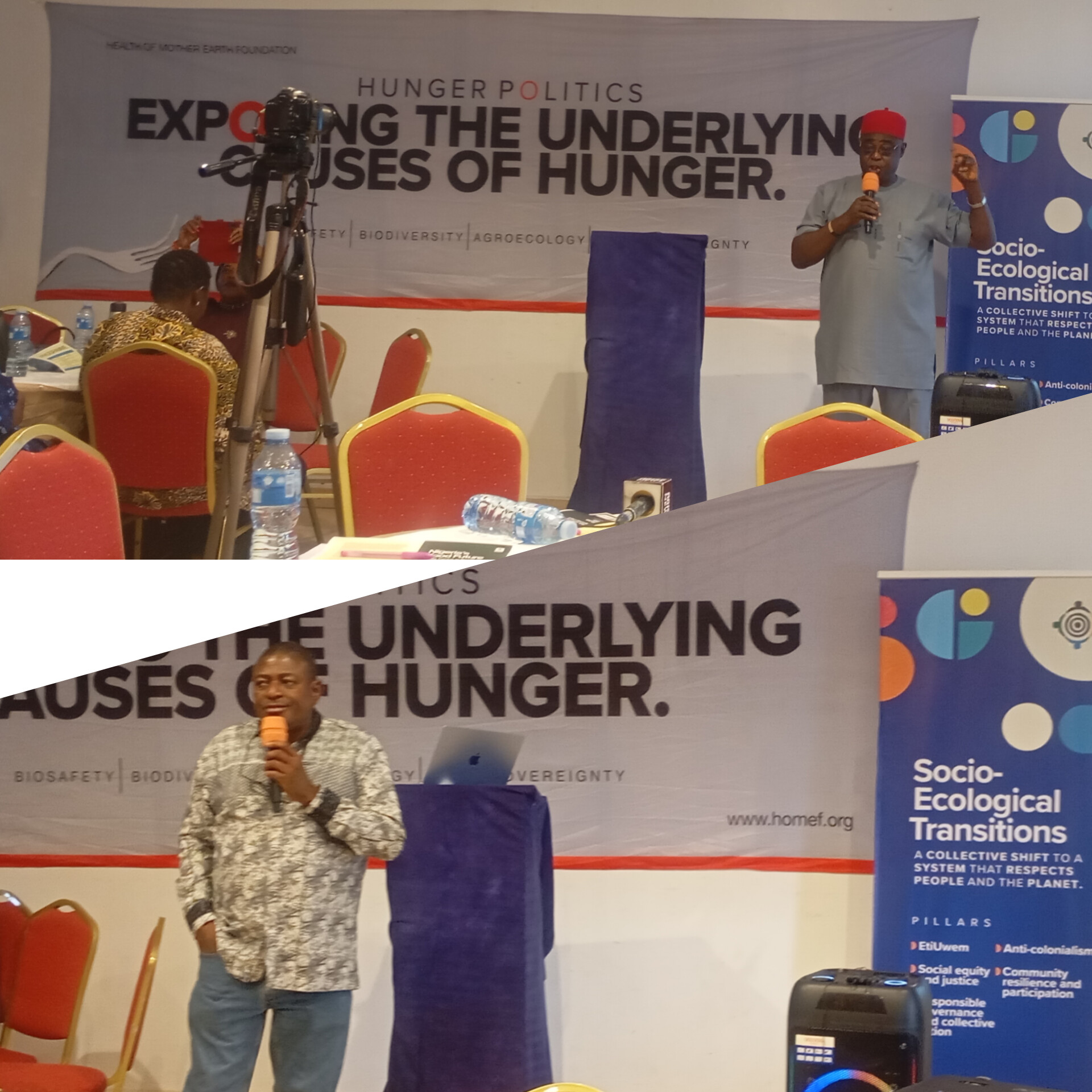
Civil society organisations have renewed calls for a review of genetically modified organism (GMO) approvals in Nigeria, urging the Federal Government to adopt agroecology as a key strategy for achieving sustainable food security.
The groups made the call during a media training on Biodiversity and Agroecology in Nigeria, themed “Nigeria’s Food Future,” organised by the Home of Mother Earth Foundation (HOMEF) and partners in Abuja.
Participants at the event raised concerns over the increasing adoption of genetically modified crops, warning that it could threaten food sovereignty, public health, biodiversity and the livelihoods of local farmers.
Executive Director of HOMEF, Nnimmo Bassey, cautioned against what he described as growing corporate influence in Nigeria’s agricultural sector, insisting that control of the country’s food system should remain with local farmers.
According to him, smallholder farmers account for more than 80 per cent of food production in Nigeria but are increasingly pressured by patented seed systems and corporate-controlled technologies.
Bassey described the trend as “food colonialism,” alleging that multinational interests were promoting dependency on proprietary seeds at the expense of indigenous farming systems.
He also questioned the effectiveness of Nigeria’s biosafety regulatory framework, raising concerns about transparency and accountability in the approval process for genetically modified crops.
Speaking at the event, public health expert, Dr. Ifeanyi Casmir, said the national conversation should focus not only on food security but also on food safety and food sovereignty.
Casmir warned that genetic modification could alter crop composition and potentially trigger allergic reactions in some consumers, while the growing use of proprietary seeds could weaken local food systems and marginalise smallholder farmers.
He further expressed concerns over the environmental and health implications of herbicides and pesticides linked to some GMO farming systems, noting that chemical residues could enter the food chain.
Executive Director of Corporate Accountability and Public Participation Africa (CAPPA), Akinbode Oluwafemi, urged the government to adopt the precautionary principle in decisions relating to GMO approvals.
Oluwafemi said several countries across the world were already taking precautionary measures over concerns about the health implications of genetically modified organisms.
He stressed the need to protect indigenous seeds and traditional farming systems, describing food production as closely tied to culture, identity and national heritage.
Presenting a communiqué issued at the end of the training, CAPPA Associate Director, Ogunlade Olamide Martins, said participants resolved to campaign for a comprehensive review of GMO approvals and biosafety regulations in Nigeria.
The communiqué called for greater transparency, public participation and independent scientific assessments in all biosafety-related decisions.
Participants also urged the government to suspend new GMO approvals pending long-term independent studies on environmental, health and social impacts.
They further called for stronger legal protections for farmers’ rights to save, exchange and reuse indigenous seeds, as well as increased public investment in agroecological research, innovation and farmer training.
In her closing remarks, HOMEF Programme Director, Joyce Brown, said Nigeria was at a critical point in deciding how to address food insecurity and climate change.
Brown noted that while some stakeholders were promoting agroecology, others continued to push for genetically modified crops, stressing the need for a clear national direction.
The groups maintained that efforts to increase food production should not come at the expense of biodiversity conservation, farmers’ rights and environmental sustainability.