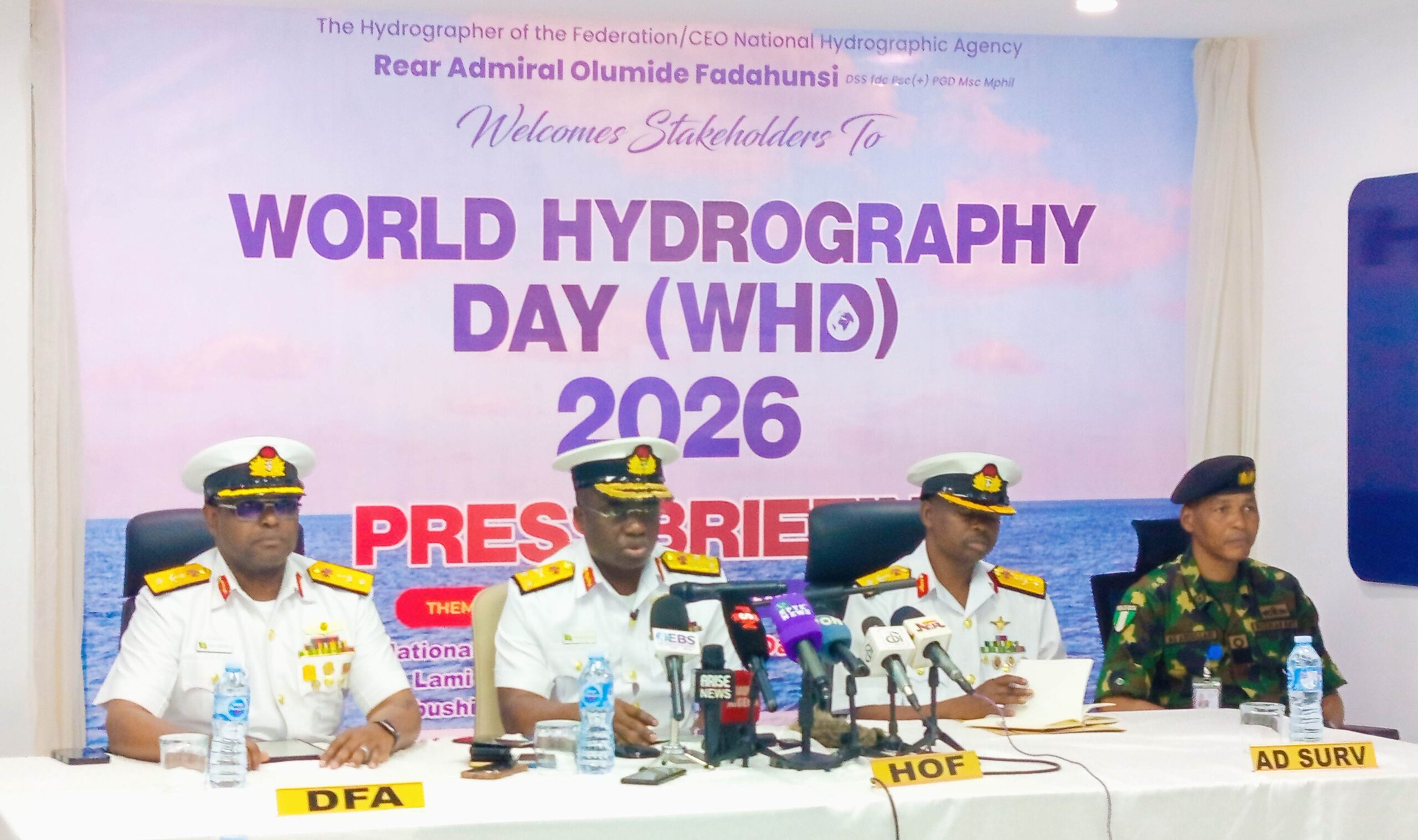
The Federal Government has reaffirmed its commitment to harnessing ocean data to improve maritime safety, enhance navigation, and support the growth of Nigeria’s blue economy as part of activities marking the 2026 World Hydrography Day.
Speaking at a press briefing in Abuja ahead of the June 20 celebration in Lagos, the Hydrographer of the Federation and Chief Executive Officer of the National Hydrographic Agency (NHA), Olumide Fadahunsi, said the country is aligning with global efforts to modernise hydrographic services and promote digital ocean-data systems.
Fadahunsi explained that the theme of this year’s celebration, “Transforming How Ocean Data is Shared,” reflects the vision of the International Hydrographic Organization to advance the use of modern hydrographic technologies and S-100-based digital ocean-data services for safer maritime operations.
According to him, improved sharing of ocean data will strengthen navigation safety, support efficient shipping activities, facilitate offshore energy operations, improve fisheries management, and enhance coastal resilience planning.
He noted that accurate hydrographic charts and ocean-data products remain essential for safe navigation, port development, environmental protection, maritime governance, and the routing of submarine cables and pipelines.
The NHA chief said the World Hydrography Day celebration would provide a platform for Nigeria to showcase the role of modern hydrography and digital ocean-data services in promoting maritime safety, trade efficiency, offshore operations, and environmental sustainability.
He disclosed that the event’s plenary session would bring together hydrographic authorities, maritime experts, policymakers, researchers, industry stakeholders, and development partners to explore strategies for strengthening navigation safety, maritime administration, and blue economy development across Nigeria and Africa.
Fadahunsi added that discussions would focus on inclusive governance of Africa’s blue economy, the use of geospatial intelligence for marine decision-making, and the strategic application of ocean data to support sustainable offshore energy development and indigenous participation in the oil and gas sector.
He emphasised the need for stronger collaboration among maritime institutions, regulators, private sector operators, and academic institutions to improve access to and governance of ocean data in line with international standards.
The hydrographer also called on the media to raise public awareness of the importance of hydrography, stressing that modern ocean-data systems are critical to maritime safety, security, climate resilience, and sustainable development.
He reaffirmed Nigeria’s commitment to global initiatives, including the United Nations Sustainable Development Goal 14 and the UN Decade of Ocean Science for Sustainable Development, aimed at ensuring the sustainable use and protection of marine resources.