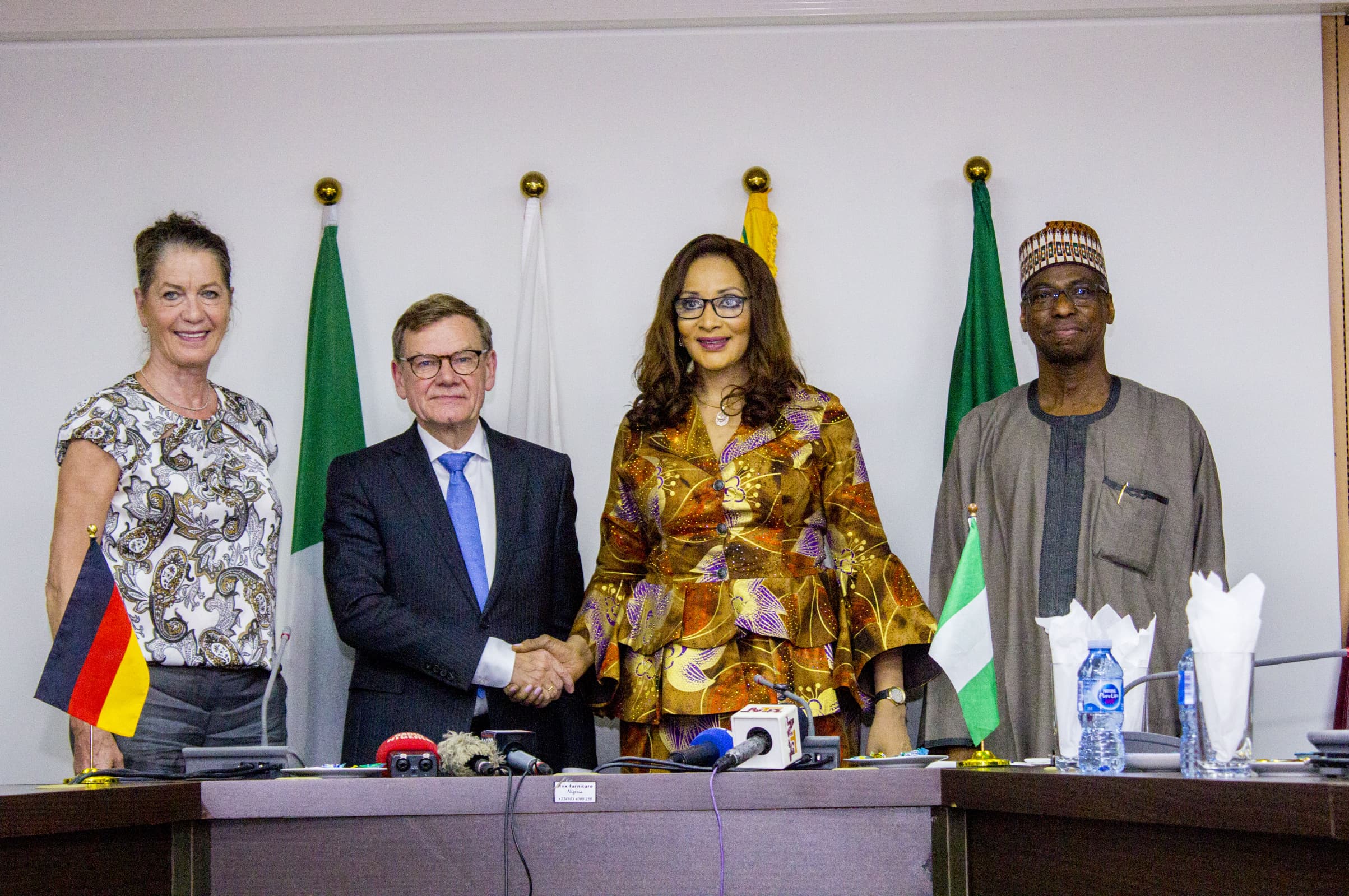
Nigeria and Germany have reaffirmed their commitment to strengthening bilateral relations, with both countries pledging closer cooperation in trade, investment, security, renewable energy and regional stability.
This was the outcome of a bilateral meeting held in Abuja on Tuesday between Nigeria’s Minister of Foreign Affairs, Ambassador Bianca Odumegwu-Ojukwu, and Germany’s Federal Minister for Foreign Affairs, Johann Wadephul.
Welcoming the German delegation, Odumegwu-Ojukwu described Germany as one of Nigeria’s most important strategic partners in Europe, noting that both countries have built a longstanding relationship anchored on mutual respect, trust and productive cooperation.
She said the partnership extends beyond diplomacy to include trade and investment, development cooperation, renewable energy, education, vocational training, science and technology, migration, culture, as well as peace and security.
The minister commended Germany’s continued support for Nigeria’s development goals and its contributions to peace and stability in West Africa, stressing that both countries must work together to address global challenges such as terrorism, violent extremism, climate change, irregular migration, food insecurity and economic uncertainty.
Odumegwu-Ojukwu said Nigeria remains committed to expanding cooperation with Germany in emerging sectors including renewable energy, digital innovation, artificial intelligence, critical minerals, manufacturing, agriculture, healthcare, infrastructure development and the green economy.
She described the Nigeria-Germany Bi-national Commission as the cornerstone of bilateral relations, noting that the successful 2025 session provided a roadmap for advancing strategic cooperation. According to her, Nigeria has continued to implement agreed resolutions through economic reforms aimed at improving the investment climate, strengthening governance and attracting greater private sector participation.
The minister also expressed appreciation for Germany’s longstanding support for the Economic Community of West African States (ECOWAS), particularly in promoting regional integration, democratic governance, peacebuilding, conflict prevention and institutional capacity development.
She urged increased German investment in Nigeria’s priority sectors, including renewable energy, manufacturing, transport infrastructure, critical minerals, agriculture and digital technology, while also calling for stronger collaboration in education, research, innovation and technical and vocational training to equip Nigerian youths with globally competitive skills.
In his remarks, German Foreign Minister Johann Wadephul highlighted the more than 65-year diplomatic relationship between both countries, recalling that Germany established its embassy in Lagos just three days after Nigeria gained independence in 1960.
He described Nigeria as Germany’s largest bilateral trading partner in Europe, revealing that trade between both countries grew by 10 per cent in the past year.
Wadephul said the Nigeria-Germany Business Forum would continue to strengthen commercial ties and expressed optimism that his visit would encourage more German investors to explore business opportunities in Nigeria.
He also reaffirmed Germany’s interest in Nigeria’s energy sector and commended the performance of the Nigeria-Germany Bi-national Commission in advancing bilateral cooperation.
The German minister further pledged Germany’s continued support for ECOWAS in addressing insecurity across West Africa, particularly terrorism and violent extremism in the Sahel region.
Both ministers expressed confidence that the discussions would further strengthen the strategic partnership between Nigeria and Germany and deliver practical outcomes that would benefit both countries.