Health stakeholders have urged stronger adoption of data-driven solutions to transform routine immunisation services and ensure children in hard-to-reach communities across Nigeria receive life-saving vaccines.
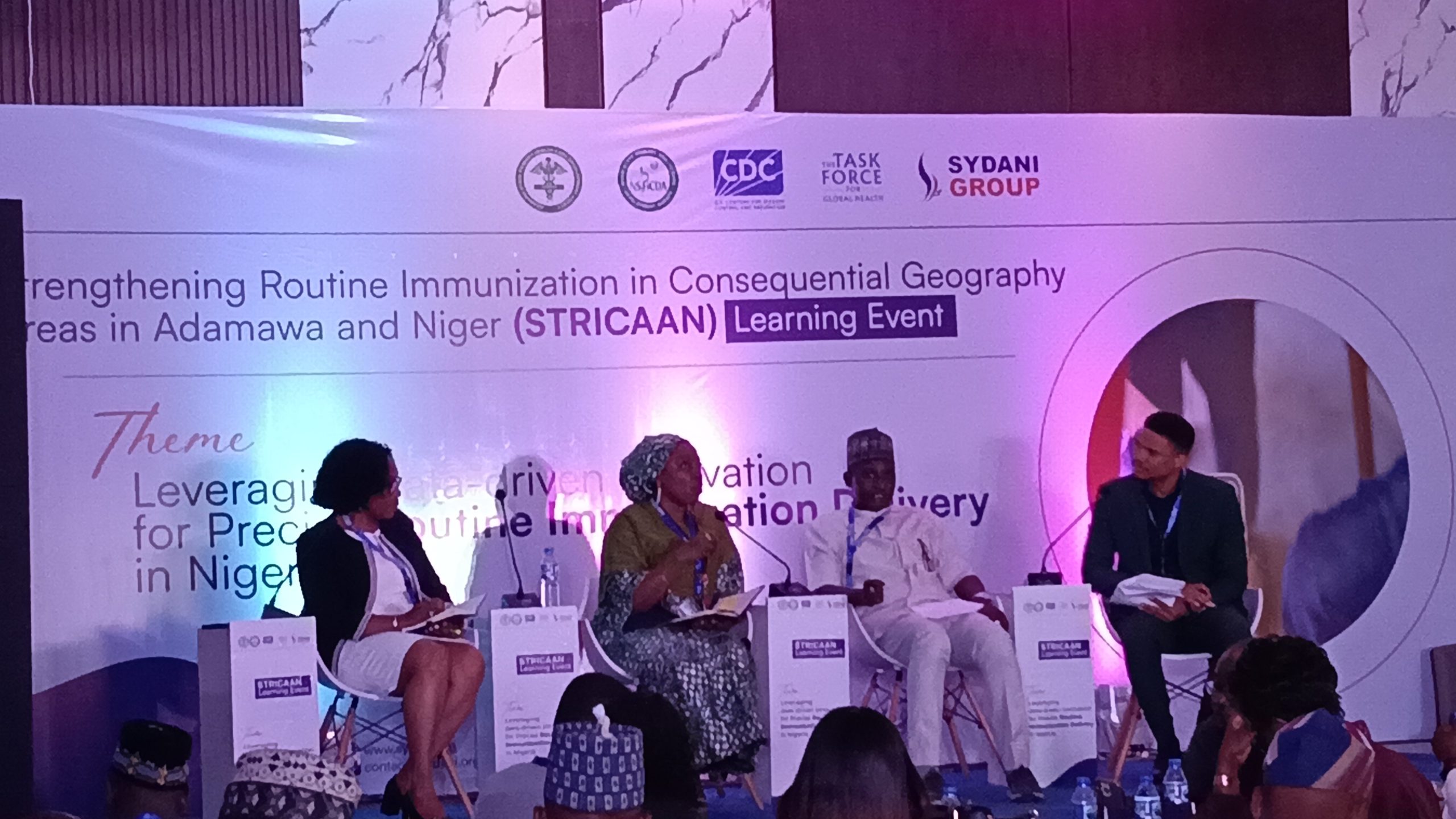
The call was made on Monday in Abuja during the learning event of the Strengthening Routine Immunisation through Continuous Accountability and Action in Nigeria (STRICAAN) project, themed “Leveraging Data-Driven Innovation for Precise Routine Immunisation Delivery in Nigeria.”
The event brought together government officials, development partners and health experts to discuss strategies for improving vaccine coverage through accurate data collection, household identification and targeted interventions.
Speaking at the event, Managing Director of Sydani Group, Sidney Sampson, said the STRICAAN initiative was developed to tackle the challenge of identifying children who are missed by routine immunisation programmes.
Sampson explained that the project moved away from relying on population estimates and assumptions by creating a platform that identifies children and households directly.
“We reflected on how best to solve this, and the idea was born. Instead of using estimates and assumptions, we decided to build a platform that would allow us to find children where they are and find households,” he said.
He added that the data collected through the platform enables health workers to accurately target communities and ensure children receive the required health interventions.
According to him, one of the project’s major achievements has been the identification of children and communities that would previously have been excluded from immunisation programmes.
“We have been able to find people, communities and children that would absolutely have been missed,” Sampson said, noting that the initiative had also gained government support to promote long-term sustainability.
The STRICAAN Programme Manager and Associate Principal at Sydani Group, Akolade Jimoh, said the project had significantly improved precision-based immunisation planning across implementing states.
He said the intervention was helping health authorities transition from broad estimates to targeted approaches that identify and reach children who have not received vaccines.
“The intervention is helping us move from broad assumptions to precise targeting, ensuring that children who would otherwise be missed are identified and reached with life-saving vaccines,” Jimoh said.
The Executive Secretary of the Niger State Primary Health Care Development Agency, Junaidu Inuwa, highlighted how the project was helping address challenges caused by outdated population data.
Inuwa said reliance on projected figures from the 2006 census had affected effective health planning due to population changes, migration and insecurity.
“For almost two decades, we’ve relied on projected population figures from the 2006 census. But with population growth, migration and insecurity, it has become difficult to use those estimates for effective planning,” he said.
He explained that STRICAAN introduced a more accurate system by mapping buildings and households, identifying eligible children and tracking those who had not received vaccines.
“People go into the field to map buildings and households, identify children and document them. That gives us the exact number of zero-dose and under-five children,” he added.
In Adamawa State, the Director of Disease Control and Immunisation at the State Primary Health Care Development Agency, Dr. Jacob Vasumu, said the project demonstrated the importance of making household identification and enumeration a permanent part of primary healthcare activities.
Vasumu said outdated population estimates had continued to affect health planning and stressed the need for decisions to be based on reliable data.
“We should move to taking decisions based on the quality of our data, but the greatest challenge has been relying on projected population figures,” he said.
He expressed optimism that lessons from STRICAAN would support improved immunisation systems beyond the pilot states and contribute to stronger vaccine delivery nationwide.
The event featured panel discussions and interactive sessions focused on lessons from the STRICAAN project, with participation from representatives of government agencies, the U.S. Centers for Disease Control and Prevention (US CDC), UNICEF, VillageReach, Johns Hopkins University, the Clinton Health Access Initiative (CHAI), PATH, Malaria Consortium and other development partners.